Tuesday, March 7, 2006

Survey shows significant support for radical Islam in Indonesia

Survey shows significant support for radical Islam in Indonesia (2004)

Survey shows significant support for radical Islam in Indonesia. A survey showed Friday that many Indonesians support the implementation of strict Islamic law, with nearly 60 percent saying they want adulterers to be whipped and 40 percent backing cutting off a thief's hand.

The survey, conducted by the U.S.-funded Freedom Institute, also found 16 percent of people polled refused to condemn terror attacks by the al-Qaida linked regional terror group Jemaah Islamiyah if they were committed to fight Muslim oppression. Still, 59 percent condemned the attacks, while 25 percent said they had no opinion.

The findings will likely rekindle concerns that radical Islam is gaining a foothold in the world's most populous Muslim nation, which has long embraced a moderate form of the religion. "It is a worrying phenomenon," said Ulil Abdala, the institute's head. "There is a strong indication that radical Islam is gaining ground. It's definitely something that moderate Indonesian Muslims must take note."

He added many uneducated Indonesians may not have access to information about the terror attacks that have hit the country in recent years or their only sources of information are militant Islamic groups.

Since 2002, Indonesia has suffered three major bombings blamed on Jemaah Islamiyah that have killed 224 people. The survey, which was carried out for the first time earlier this month, showed many Indonesians support the establishment of laws based on the Muslim holy book Quran. Fifty-nine percent of people polled backed whipping adulterers and 40 percent said thieves should have their hands hacked off. Meanwhile, 39 percent said they support polygamy for men and 40 percent oppose a women becoming president.

Many Indonesian Muslims also expressed intolerant attitudes toward Christians, with 50 percent saying they oppose churches in Muslim-majority areas, the survey said. A Catholic school near Jakarta was closed for three weeks in October when a Muslim group built the two-meter-high (seven-foot-high) wall in front of its gates. The group accused the school of aggressive proselytizing.

However, 82 percent of Indonesians oppose a hardline militant group, the Islamic Defenders Front, which is notorious for raiding Western cafes and bars during the holy month of Ramadan.

The Freedom Institute surveyed 1,200 people in all 32 provinces, and the poll had a margin of error of 3 percent.

More than 85 percent of the country's 210 million people are Muslims, while Christians are 8 percent, Hindus 2 percent and Buddhists less than 1 percent.

Survey shows significant support for radical Islam in Indonesia from the Associated Press November 12, 2004 (Includes Jakarta Post's report of same survey)
cached link


Humanitarian Relief Sustains Change in Muslim Public Opinion(2006)


A new poll by Terror Free Tomorrow demonstrates that one year after the tsunami in Indonesia , the dramatic increase in Indonesian support for the United States and against Bin Laden has continued.

American humanitarian aid to tsunami victims last year caused an overwhelming change of opinion in Indonesia , the world’s largest Muslim country. The new nationwide poll throughout Indonesia reveals that this dramatic shift has not only been sustained, but has strengthened.

The fact that more than a year after American help, Indonesians continue to appreciate America’s role is stunning proof of the sustained power of positive and substantial assistance to radically change Muslim public opinion. Despite widespread stories on Koran desecration, Guantanamo , even the Danish cartoons, favorable opinion toward the United States in Indonesia has actually increased from 34 percent a year ago to 44 percent at the end of January 2006, while unfavorable views declined from 54 percent to 41 percent.

The overwhelming reason for these changes continues to be American humanitarian relief. The increased favorable view of the United States occurred in tandem with similar declines in support for Bin Laden and terrorism.

Key Findings of the Poll:

For the first time in almost four years, more Indonesians are favorable to the United States than unfavorable, while support for Bin Laden and terrorism has dropped to its lowest level since 9/11.

63% of Indonesians continue to have a more favorable opinion of the United States because of the American response to the tsunami more than a year later.

Favorable opinion among Indonesians to the United States has nearly tripled from 15% in May 2003 to 34% in January 2005 and more than 44% now, while the percentage of Indonesians with very unfavorable views declined from 48% in May 2003 to 21% last January and just 13% today.

United States fared better in Indonesian public opinion than other Western countries, other Islamic countries and local Islamist groups.

Only a mere 2% of Indonesians surveyed now believe suicide terrorist attacks are ever justified, down from 27% after 9/11, and 9% last year.
Support for Osama Bin Laden has declined significantly (58% favorable in May 2003 to 23% a year ago and just 12% now).

Critical Implications:
American humanitarian assistance can make a significant and long-term difference in building goodwill toward the United States and eroding popular support for global terrorists. The United States must sustain its relief and reconstruction efforts in in order to prevent popular support for Islamist radicalism from rebounding. Indeed, a majority of Indonesians want continued American assistance.

The poll follows similar findings from previous Terror Free Tomorrow public opinion surveys in Indonesia, Pakistan and the Palestinian Territories. 78% of Pakistanis had a more favorable opinion of the United States because of American earthquake relief.

Similarly, a strong majority of Palestinians want the United States to become more involved in resolving the Palestinian/Israeli conflict.

These public opinion surveys, in three distinct regions of the Muslim world, demonstrate for the first time that American policies based on humanitarian interventions result in sustained, substantial, and favorable changes in Muslim opinion.

Picked up here from Patung's imformative site Indonesia Matters


For the complete poll results and report, including methodology, click here (Word), click here (PDF).
From Terror Free tomorrow:
Humanitarian Relif Sustains change in Muslim Public Opinion


Survey shows significant support for radical Islam in Indonesia

Survey shows significant support for radical Islam in Indonesia (2004)

Survey shows significant support for radical Islam in Indonesia. A survey showed Friday that many Indonesians support the implementation of strict Islamic law, with nearly 60 percent saying they want adulterers to be whipped and 40 percent backing cutting off a thief's hand.

The survey, conducted by the U.S.-funded Freedom Institute, also found 16 percent of people polled refused to condemn terror attacks by the al-Qaida linked regional terror group Jemaah Islamiyah if they were committed to fight Muslim oppression. Still, 59 percent condemned the attacks, while 25 percent said they had no opinion.

The findings will likely rekindle concerns that radical Islam is gaining a foothold in the world's most populous Muslim nation, which has long embraced a moderate form of the religion. "It is a worrying phenomenon," said Ulil Abdala, the institute's head. "There is a strong indication that radical Islam is gaining ground. It's definitely something that moderate Indonesian Muslims must take note."

He added many uneducated Indonesians may not have access to information about the terror attacks that have hit the country in recent years or their only sources of information are militant Islamic groups.

Since 2002, Indonesia has suffered three major bombings blamed on Jemaah Islamiyah that have killed 224 people. The survey, which was carried out for the first time earlier this month, showed many Indonesians support the establishment of laws based on the Muslim holy book Quran. Fifty-nine percent of people polled backed whipping adulterers and 40 percent said thieves should have their hands hacked off. Meanwhile, 39 percent said they support polygamy for men and 40 percent oppose a women becoming president.

Many Indonesian Muslims also expressed intolerant attitudes toward Christians, with 50 percent saying they oppose churches in Muslim-majority areas, the survey said. A Catholic school near Jakarta was closed for three weeks in October when a Muslim group built the two-meter-high (seven-foot-high) wall in front of its gates. The group accused the school of aggressive proselytizing.

However, 82 percent of Indonesians oppose a hardline militant group, the Islamic Defenders Front, which is notorious for raiding Western cafes and bars during the holy month of Ramadan.

The Freedom Institute surveyed 1,200 people in all 32 provinces, and the poll had a margin of error of 3 percent.

More than 85 percent of the country's 210 million people are Muslims, while Christians are 8 percent, Hindus 2 percent and Buddhists less than 1 percent.

Survey shows significant support for radical Islam in Indonesia from the Associated Press November 12, 2004 (Includes Jakarta Post's report of same survey)
cached link


Humanitarian Relief Sustains Change in Muslim Public Opinion(2006)


A new poll by Terror Free Tomorrow demonstrates that one year after the tsunami in Indonesia , the dramatic increase in Indonesian support for the United States and against Bin Laden has continued.

American humanitarian aid to tsunami victims last year caused an overwhelming change of opinion in Indonesia , the world’s largest Muslim country. The new nationwide poll throughout Indonesia reveals that this dramatic shift has not only been sustained, but has strengthened.

The fact that more than a year after American help, Indonesians continue to appreciate America’s role is stunning proof of the sustained power of positive and substantial assistance to radically change Muslim public opinion. Despite widespread stories on Koran desecration, Guantanamo , even the Danish cartoons, favorable opinion toward the United States in Indonesia has actually increased from 34 percent a year ago to 44 percent at the end of January 2006, while unfavorable views declined from 54 percent to 41 percent.

The overwhelming reason for these changes continues to be American humanitarian relief. The increased favorable view of the United States occurred in tandem with similar declines in support for Bin Laden and terrorism.

Key Findings of the Poll:

For the first time in almost four years, more Indonesians are favorable to the United States than unfavorable, while support for Bin Laden and terrorism has dropped to its lowest level since 9/11.

63% of Indonesians continue to have a more favorable opinion of the United States because of the American response to the tsunami more than a year later.

Favorable opinion among Indonesians to the United States has nearly tripled from 15% in May 2003 to 34% in January 2005 and more than 44% now, while the percentage of Indonesians with very unfavorable views declined from 48% in May 2003 to 21% last January and just 13% today.

United States fared better in Indonesian public opinion than other Western countries, other Islamic countries and local Islamist groups.

Only a mere 2% of Indonesians surveyed now believe suicide terrorist attacks are ever justified, down from 27% after 9/11, and 9% last year.
Support for Osama Bin Laden has declined significantly (58% favorable in May 2003 to 23% a year ago and just 12% now).

Critical Implications:
American humanitarian assistance can make a significant and long-term difference in building goodwill toward the United States and eroding popular support for global terrorists. The United States must sustain its relief and reconstruction efforts in in order to prevent popular support for Islamist radicalism from rebounding. Indeed, a majority of Indonesians want continued American assistance.

The poll follows similar findings from previous Terror Free Tomorrow public opinion surveys in Indonesia, Pakistan and the Palestinian Territories. 78% of Pakistanis had a more favorable opinion of the United States because of American earthquake relief.

Similarly, a strong majority of Palestinians want the United States to become more involved in resolving the Palestinian/Israeli conflict.

These public opinion surveys, in three distinct regions of the Muslim world, demonstrate for the first time that American policies based on humanitarian interventions result in sustained, substantial, and favorable changes in Muslim opinion.

Picked up here from Patung's imformative site Indonesia Matters


For the complete poll results and report, including methodology, click here (Word), click here (PDF).
From Terror Free tomorrow:
Humanitarian Relif Sustains change in Muslim Public Opinion


Thursday, March 2, 2006

Keysar and the Convicts

For those of you not in Australia, Keysar is the most known moderate muslim in Australia these days.
All to often on TV talking about the misunderstood islamic youth and possible solutions...

So who is Keysar Trad pissed off with?
Just these guys: Rwanda, some South American coutries, Australia, America, Canada, The French, The British, The Germans, The Comunists, The Chinese, Africa, Isreal and India.

http://network.news.com.au/image/0,10114,5028230,00.jpg

It’s funny to see the pot call the kettle black, he’s the one on TV every night crying racism.

This is his writing from 1996/7.... its vile, please post it far and wide, lets show people what these moderates are up to.


"our ideology is the best salvation for the people of Australia, and the people of the world in general. Yes, we are a threat to the culture of drunkenness, paedophilia, and mostly we are a big threat to the culture of ELITISM."

"In a way, they feel safe because of the quantity of water which surrounds this country, so they feel fortified behind this great body, it gives them a feeling of security. But the reality is, the land belongs to God, not to them, and if those foreigners, whom they fear as migrants are not permitted to enter as migrants, they will come as settlers, in numbers so large that they will not be able to process them, hold them, or stop them. What will they do then? If these foreigners who are restraining themselves, because they see a legal hope, that they can come to this vast mainly uninhabited land for whatever reason, are told that there is no longer a legal way to come here, what will they do?"

Sounds like the answer to Keysar’s question is jihad on Australia.

Presently we are experiencing the social aspect of jihad, colonization,pro sharia propaganda, legislation and civil threats and violence.

Read it all here:

Racism: An Islamic response.was first published in the 16th issue of Nida'ul Islam magazine (http://www.islam.org.au),December - January 1996-97)

Thanks to
Democracy Front Line for spreading the word


Keysar and the Convicts

For those of you not in Australia, Keysar is the most known moderate muslim in Australia these days.
All to often on TV talking about the misunderstood islamic youth and possible solutions...

So who is Keysar Trad pissed off with?
Just these guys: Rwanda, some South American coutries, Australia, America, Canada, The French, The British, The Germans, The Comunists, The Chinese, Africa, Isreal and India.

http://network.news.com.au/image/0,10114,5028230,00.jpg

It’s funny to see the pot call the kettle black, he’s the one on TV every night crying racism.

This is his writing from 1996/7.... its vile, please post it far and wide, lets show people what these moderates are up to.


"our ideology is the best salvation for the people of Australia, and the people of the world in general. Yes, we are a threat to the culture of drunkenness, paedophilia, and mostly we are a big threat to the culture of ELITISM."

"In a way, they feel safe because of the quantity of water which surrounds this country, so they feel fortified behind this great body, it gives them a feeling of security. But the reality is, the land belongs to God, not to them, and if those foreigners, whom they fear as migrants are not permitted to enter as migrants, they will come as settlers, in numbers so large that they will not be able to process them, hold them, or stop them. What will they do then? If these foreigners who are restraining themselves, because they see a legal hope, that they can come to this vast mainly uninhabited land for whatever reason, are told that there is no longer a legal way to come here, what will they do?"

Sounds like the answer to Keysar’s question is jihad on Australia.

Presently we are experiencing the social aspect of jihad, colonization,pro sharia propaganda, legislation and civil threats and violence.

Read it all here:

Racism: An Islamic response.was first published in the 16th issue of Nida'ul Islam magazine (http://www.islam.org.au),December - January 1996-97)

Thanks to
Democracy Front Line for spreading the word


Wednesday, March 1, 2006

Who is Keysar Trad

So who is Keysar Trad,

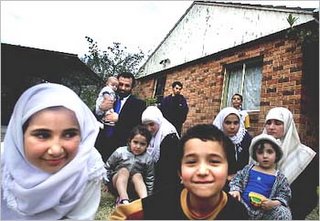
All in the family
... Keysar Trad and his wife,

Hanifeh (right), with their children at
their Yagoona home. Photo: Ben Rushton


You might think a concerned Muslim moderate we see a few times a week on our News broadcasts here in Australia.

Here from some soft pro sharia propaganda in the Sydney Morning Herald(by Deborah Cameron in 2002), we can still plainly see that he is no asset to Australia.

Keysar, and quiet a few other in-laws, arrived in Sydney via some handy polygamy loopholes at 13 years old.


Keysar worked at the Tax Office but quit in 1998 for his religious needs and a trip to Lebanon. He came home to “write”. Here is a sample of the religious writing from those years

Mr. Trad has 2 wives and 9 children here in Australia…He talks to the SMH about installing a deep moral code into his 9 children. In 2002 at the year of this interveiw Keysar was at a forum at Western Sydney Uni promoting some islamic moral codes on homosexuality

Keysar and his large family qualify for low income supprt.

More from Keysar's website on poly

Read SMH article:
October 2 2002 Sydney Morning Herald(by Deborah Cameron in 2002).


Who is Keysar Trad

So who is Keysar Trad,

All in the family
... Keysar Trad and his wife,

Hanifeh (right), with their children at
their Yagoona home. Photo: Ben Rushton


You might think a concerned Muslim moderate we see a few times a week on our News broadcasts here in Australia.

Here from some soft pro sharia propaganda in the Sydney Morning Herald(by Deborah Cameron in 2002), we can still plainly see that he is no asset to Australia.

Keysar, and quiet a few other in-laws, arrived in Sydney via some handy polygamy loopholes at 13 years old.


Keysar worked at the Tax Office but quit in 1998 for his religious needs and a trip to Lebanon. He came home to “write”. Here is a sample of the religious writing from those years

Mr. Trad has 2 wives and 9 children here in Australia…He talks to the SMH about installing a deep moral code into his 9 children. In 2002 at the year of this interveiw Keysar was at a forum at Western Sydney Uni promoting some islamic moral codes on homosexuality

Keysar and his large family qualify for low income supprt.

More from Keysar's website on poly

Read SMH article:
October 2 2002 Sydney Morning Herald(by Deborah Cameron in 2002).


Keysar Trad SMH Oct 2, 2002

Islam's man of a million comments

October 2 2002


All in the family ... Keysar Trad and his wife, Hanifeh (right), with their children at their Yagoona home. Photo: Ben Rushton

Recent events have focused attention on Muslims in a way never before considered. Deborah Cameron profiles one of the Sydney community's leading lights.

Pink pickled turnip and little sprigs of mint tumble out of the pita bread as Keysar Trad hits the kerb in his big old Pajero.

He is taking a short cut between his favourite falafel shop and a cafe where the walls are lined with jars of honey and bottles of rosewater.

The wheel thumps hard. The four-year-old in front lets out a squawk. His wife, Hanifeh, sitting in the back with the two-year-old, tut-tuts at him driving, eating, talking and winding down the windows, more or less at the same time.

Pulling up at the Farouk and Chehade El Bahsa Sweets shop in South Bankstown, everyone is ready for the ice-cream which comes in about 10 colours. It is practically an insult to order one scoop of pistachio. "You must taste every colour," insists Trad, handing over a deep silver bowl and spoon.

Outside it is warm. Hanifeh, covered from head to toe in a long dark-coloured dress and headscarf, looks cooler than she probably feels. For a woman of 38 with nine children, no money to spare and a husband devoted to voluntary community work, her face is free of worry. She is even at ease with what she calls "Keysar's pet topic": a second wife.

Trad is director of the Lebanese Muslim Association and, because the times have demanded it, an increasingly well-known community spokesman. He is a refugee advocate and translator, an essayist, a spokesman on political issues, a critic of racial labelling by police, a close adviser to the Mufti Sheik Taj el-Din Al Hilaly and a calm interpreter of Islam to the nervous broader community.

He gets frustrated with the association and has quit at least twice this year but returned out of a sense of duty and an instinct that it would revert to a "no comment" approach to the media which would be wrong at a time like this. Within his community he is criticised for publicly discussing refugees, Lebanese gang rapes and Islamic attitudes.

"They say when a Muslim speaks it is an admission that Islam has a problem," Trad says. "They say you don't see them filming churches when a Christian commits a rape or a murder, so why are you letting them come to interview you at the mosque? They don't realise that the media comes anyway. They tell me - just say "no comment" - but I have a million comments. They cannot censor me. I answer the questions sensibly and we have got nothing to hide."

TRAD and Hanifeh have been through a lot. They met in Lebanon when they were both about 22. They married after three weeks and she came to live with her new husband and mother-in-law in Yagoona. Trad worked at the Australian Tax Office while Hanifeh took English classes. "I find it hard to believe these mothers who cannot understand their children's language or who are dependent on their children for translation," she says.

Hanifeh, a law student in Lebanon, worked as an editor and journalist on Arabic publications in Sydney and studied computer science after emigrating. But when her fourth child was born, family took over.

It has not been easy and they remember 1998 as their worst year when Trad fell in love - "became obsessed", his wife says - with another woman. In desperation, Hanifeh proposed marriage on her husband's behalf to the other woman. "We were having a terrible time. He fell in love and I wasn't thinking about myself," she says. But his obsession passed. "He became more compassionate after it," Hanifeh says. "God meant for him to go through this experience and it made him a better person and more emotionally aware. It knocked him off his perch."

Hanifeh was not heartbroken. A second wife would have meant divorce (though he was against it) or living under the same roof as her husband's mistress. As long as the arrangement was fair and had the consent of all involved, it would be acceptable. Hanifeh loves her husband and the children, but says she is not strong enough, physically or emotionally, for more babies.

Aware that Australian law prohibits polygamy, they know a second wife could never be official. But their religion allows a man four wives and though a lot of what they say to each other about polygamy amounts to teasing, there is also a serious thread. It was Hanifeh who first raised it, approvingly, before they married.

Trad and Hanifeh say Islam is central to their values and the most important thing they can impart to their children. A strong set of beliefs is needed to resist society's temptations. Both were raised in large devout families - Trad the eldest son of his father's third wife, and Hanifeh a middle daughter in a family of 12 - and they have accepted the same model for themselves.

Trad arrived in Australia at 13 as part of a family reunion complicated by polygamy. His half-brother who had settled in Sydney got permission to bring his mother and siblings from Lebanon. Because his mother was married, she was able to bring her husband. At the time her husband was married to two other women. One of them (Trad's mother) came along, too, with her children. The older wife divorced her husband in Australia and the patriarch lived with Trad's mother.

To Trad's regret his father, in his 60s then, did not adjust. He could not find full-time work in Sydney. "Isn't it a shame for a grown man not to have a job," he would say, even as he neared death at 80. His father eventually returned to Lebanon which left Trad - as a teenager - responsible for his mother and the younger children.

After ice-cream, the family returns to the house Trad calls "the untidiest in street". In the lounge, three couches are pushed back against walls in need of painting. Bits of jute poke out of the plaster rubbed raw by chairs. A coffee table is laid with almonds, preserved green plums, sweet biscuits, glasses of cold delicious Lebanese cordial tasting like liquified quinces, and the baby capsule bearing the youngest child cooing and kicking his legs.

Trad is opening mail and wonders whether a letter from the council might be to direct him to mow the grass. Instead, it concerns the baby's immunisations. "Give this to your mum," he tells the four-year-old who has walked into the room prattling about The Simpsons and clutching a pencil case, two colouring books and an oven mitt.

In the same post is a statement from the Public Service superannuation fund. He reads out the balance which is tiny. "Money means nothing to me," he says. The family qualifies for low-income support. Trad is prepared for more years of financial hardship.

For the children, it means few toys and a scant wardrobe. "I can see when my son needs new pants but he doesn't talk about it," Hanifeh says. "The kids don't ask for too much." Hanifeh reads the employment section on his behalf, but one of the children put it well: "Dad doesn't need a job; he needs a miracle to make him rich."

The mayhem that comes with nine children in a modest house does not faze them. Even on a school day with six of the kids at local public high and primary schools, the three youngest are a distraction. Conversation occurs against a background of slamming doors, kids yelling and toys being dropped, with neither parent worried. They wipe runny noses and finish complicated anecdotes.

"Imagine if our children grow up with good values like we are trying to give them,"says Trad, "Imagine what great people they'll be for society. I have to make sure that they are positive, contributing members. I will be happy if their sense of social justice is very strong."

Trad's faith has had its phases. It was least strong in Lebanon when he lived among non-practising Muslims who rarely prayed at mosques and did not have access to religious texts. Arriving in Australia he was advised by his half-brother to keep quiet about religion, to be careful around women and to change his name. His half-brother went by the surname Wilson.

For the first few years Trad did not talk about his religion. "People could see that my mother covered her hair; they knew that I was Muslim but I couldn't talk about it because I didn't know where to begin," Trad says.

He was gradually drawn in, especially after a 1987 pilgrimage to Mecca with his mother that he regards as his spiritual turning point. After that he prayed five times a day on schedule, even at the office.

"I was adamant that if someone could take a five-minute break for a ciggie, I could sit at my workstation and pray for five minutes," Trad said. "I was on good terms with my boss and she said it was OK. Initially people made jokes about me headbutting my head against the carpet or by flicking rubber bands while I was praying. But they were my close friends so it didn't matter. It was nothing."

Trad resigned from the ATO at the end of 1998, the year of his infatuation. It was a decision with some familiar elements for anyone who has had a mid-life crisis or considered a sea change. A decade after his Mecca visit he wanted to do religious work. He travelled with his family to Lebanon for three months and returned home to write.

Known at the Lakemba Mosque as a translator, the Mufti asked him to take a more prominent role. Trad is a natural communicator in a community that is not blessed with them and, with his Public Service background, knows the limits in political debate. (When an Iraqi acquaintance once made a colourful reference to Jews, Trad ticked him off.) Instead of being suspicious and defensive with talkback callers, politicians and journalists, he is prepared to explain.

The Public Service also made him confront some of his practices - he cropped his beard and, after a debate with himself, started shaking hands with women. "I kept saying, 'Please don't be offended' but a couple of them were honest and said that they were offended. And I thought - do I really have to be so strict?"

Sydney Morning Herald article

Cached